

Upgrading Sonar During a Refit: What to Know Before You Splash
When a sportfishing boat goes into the yard, the haul-out creates an opportunity that doesn't exist at the dock: clean hull access. For captains who've been living with an aging searchlight sonar, or who want to step up to omni scanning technology, the refit window is the time to do it.
At O-Sea-D Marine Electronics, we handle sonar upgrades as part of full electronics refits on sportfish vessels throughout South Florida to the Treasure Coast. Here's what the process involves and what's worth thinking through before your boat goes in the slings.
Why a Yard Period Is the Right Time
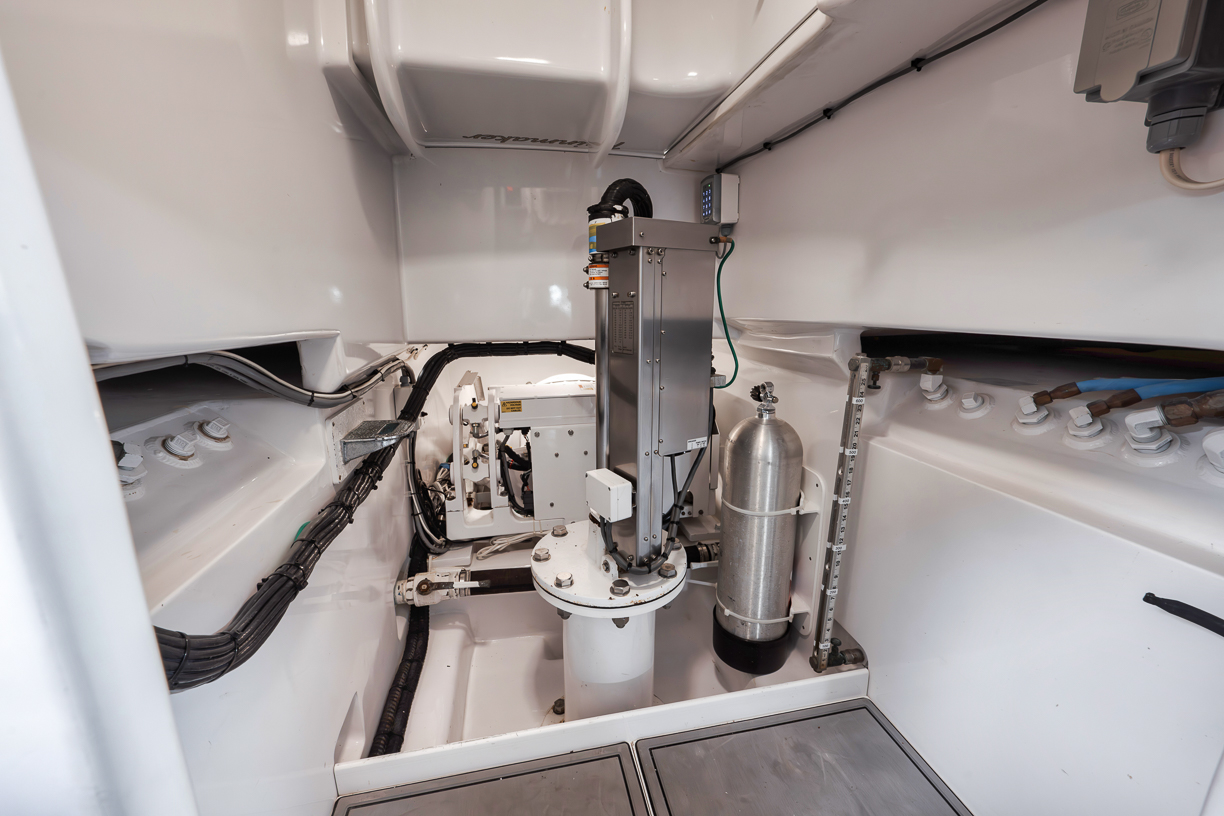
Sonar transducers are through-hull fittings. Installing, replacing, or relocating one requires hull access — which means the boat needs to be out of the water. Working in a wet slip on sonar tube installation is possible in limited situations, but it's not the environment where precision work happens.
With the boat on the hard, the full scope of the job is accessible: hull boring, tube installation, structural reinforcement, fairing, and waterproofing — all done correctly and inspected before the boat goes back in. For vessels moving from a six-inch searchlight tube to an eight-inch omni sonar, that hull work is significant. It's a structural job, not an accessory swap, and it needs to happen in the yard.
The other practical argument for doing sonar work during a refit is sequencing. Sonar integration touches the helm electronics network — chartplotters, MFDs, and in some cases autopilot and AIS. Doing that integration while the boat is already opened up for electrical and systems work reduces overall labor and avoids disturbing a completed installation later.
Searchlight vs. Omni: Understanding the Step Up
Most sportfish vessels built before the last several years came out of the factory with a searchlight sonar — a mechanically rotating transducer that sweeps a sector of water ahead and below the hull. It works. But it's slow relative to what omni scanning technology does.
An omni sonar uses a fixed phased-array transducer that fires in all directions simultaneously, updating a full 360-degree display continuously. No sweep. No lag. Fish moving in any direction around the vessel are visible in real time, not between sweeps.
For competitive offshore fishing — blue marlin, yellowfin, wahoo — the difference is measurable. Captains who've made the switch consistently report marking bait balls and fish schools that would have gone unseen with their previous equipment, sometimes several hundred yards away from the vessel's track.
Learn more about sonar installation and fish finding systems →
The Furuno CSH-8L Mark-2 and CSH-10
Furuno's omni scanning sonar lineup represents the current standard for serious offshore sportfishing. We install and commission both the CSH-8L Mark-2 and the newer CSH-10.
The CSH-8L Mark-2 uses 420 sonar elements firing simultaneously at 85 kHz, updating the full 360-degree display every 0.54 seconds. Detection range extends to 5,000 feet. It integrates with Furuno NavNet TZtouch2 and TZtouch3 multifunction displays and connects to GPS for auto-retract above a preset speed threshold — a practical feature on a working tournament boat.
The CSH-10, introduced at the 2024 Fort Lauderdale Boat Show, builds on the CSH-8L platform with an expanded 32-color palette, beam stabilization for rough-sea performance, Target Lock for tracking individual fish or schools, and Sonar Chart Overlay — displaying real-time sonar echoes directly over bathymetric chart data on the NavNet TZtouchXL. Detection range extends to 900 meters.
For CSH-8L owners considering a step up, the CSH-10 uses the same hull tube footprint as the CSH-8L. A refit is the logical time to make that move — the tube stays, the sonar upgrades.